Something a bit different for our last day in Italy / SüdTyrol – we got a sudden urge to see some rocks balancing on sticky-up bits of limestone.
As luck would have it, the next valley west from us advertises the Percha Earth Pyramids as its leading attraction. Just the job ! Or jobby , in fact – as our guide along the trail resembles a cartoon poo more than it does a pyramid , at least to my eyes.
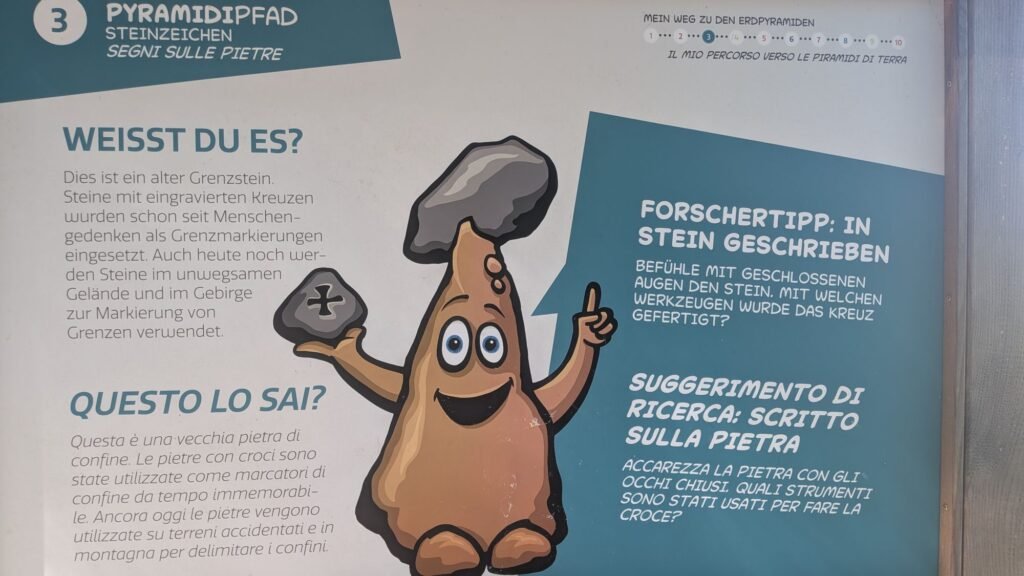
After a couple of km along the trail, we come to a sign which actually tries to explain the phenomenon for adults –
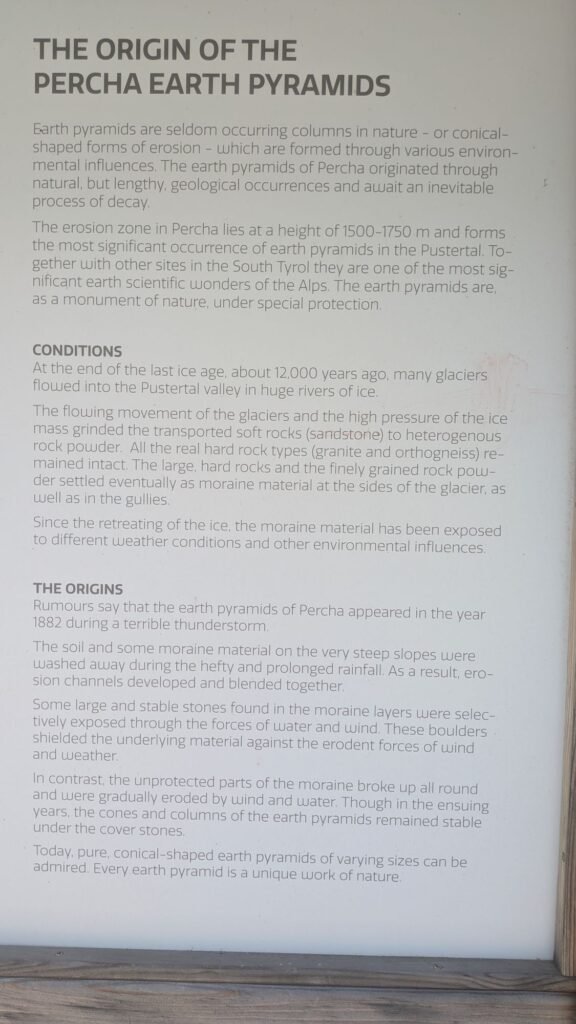
Now , I know many of you, Gentle Readers, are of a scientific persuasion. You deal in clear definitions, unambiguous categorisation, …. So the stuff about moraine erosion is OK, ( especially when there’s a lot mo-raine than usual, as in 1882) but I fear you may be struggling with the concept of ‘conical-shaped pyramids‘. Now, as any fule kno, the classical definitions are
– A cone is a three-dimensional figure that tapers smoothly from a flat base (typically a circle) to a point not contained in the base, called the apex or vertex.
– A pyramid is a polyhedron formed by connecting a polygonal base and a point, called the apex. Each base edge and apex form a triangle, called a lateral face.
I have never personally seen a triangular face on a cone ( and if I ever did find one, I’d be demanding a refund from Mr Whippy ). But if you can include a circle as a polyhedron, then maybe , maybe it’s not impossible for such a description to make sense.
So have a look and tell me if you see pyramids, cones, or what ?
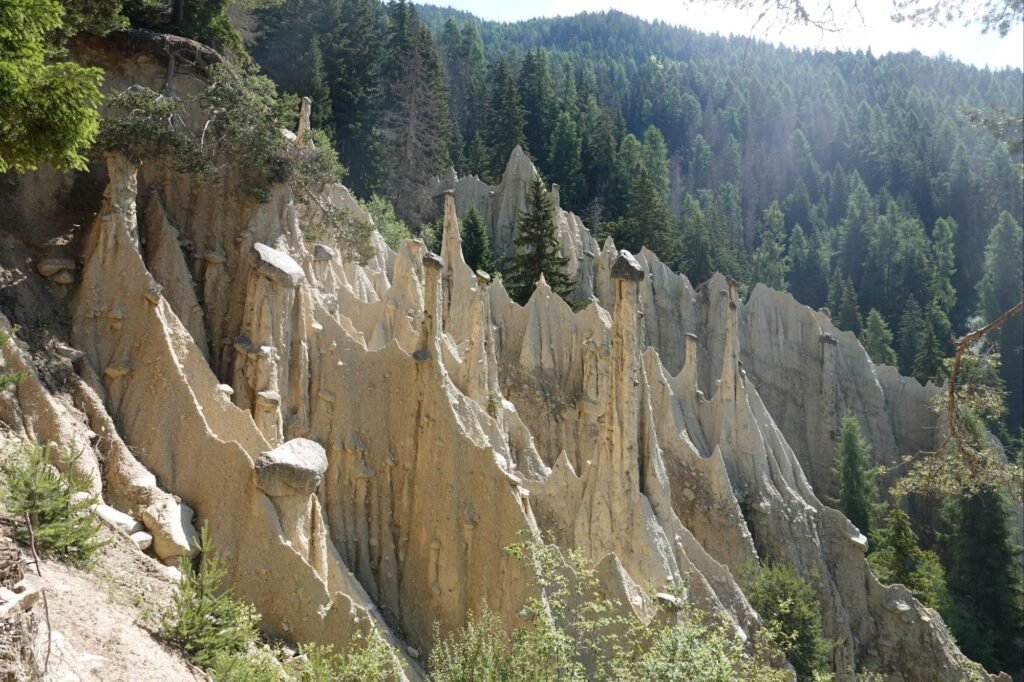
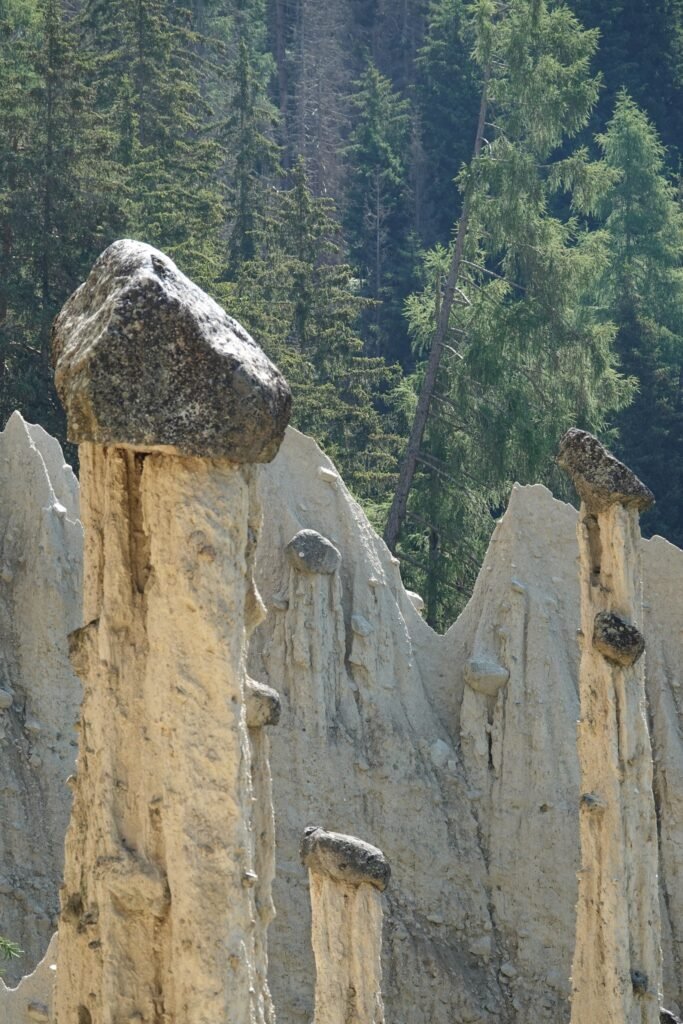
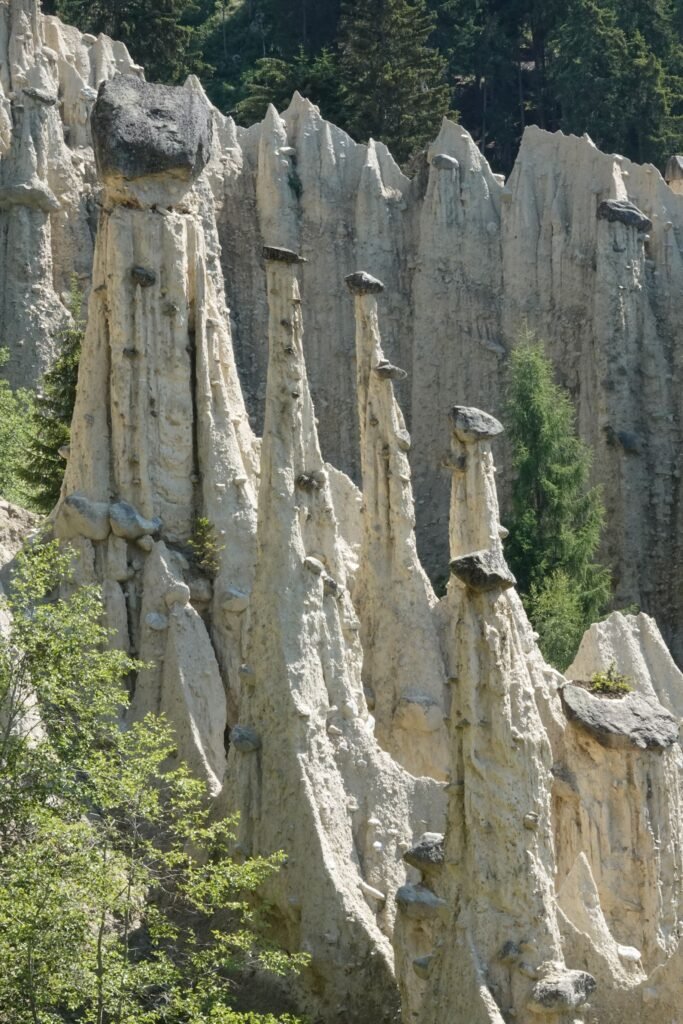
It was a fascinating sight, but I’m just not sold on them as pyramids.
What do our readers think ?
Discover more from PlainSillyBloggers
Subscribe to get the latest posts sent to your email.
Well, of course, Matt’s yer maths man. But I could posit the theory that a cone is a pyramid with an infinite number of sides.
You could indeed !
Generalized Cones: The mathematical term for any three-dimensional geometric shape formed by rays emanating from a fixed point (vertex) and passing through a closed planar curve (the base).
However, i much prefer meerkats
“Compare the Generalized Cone Dot Com” just doesn’t have the same ring, does it?